
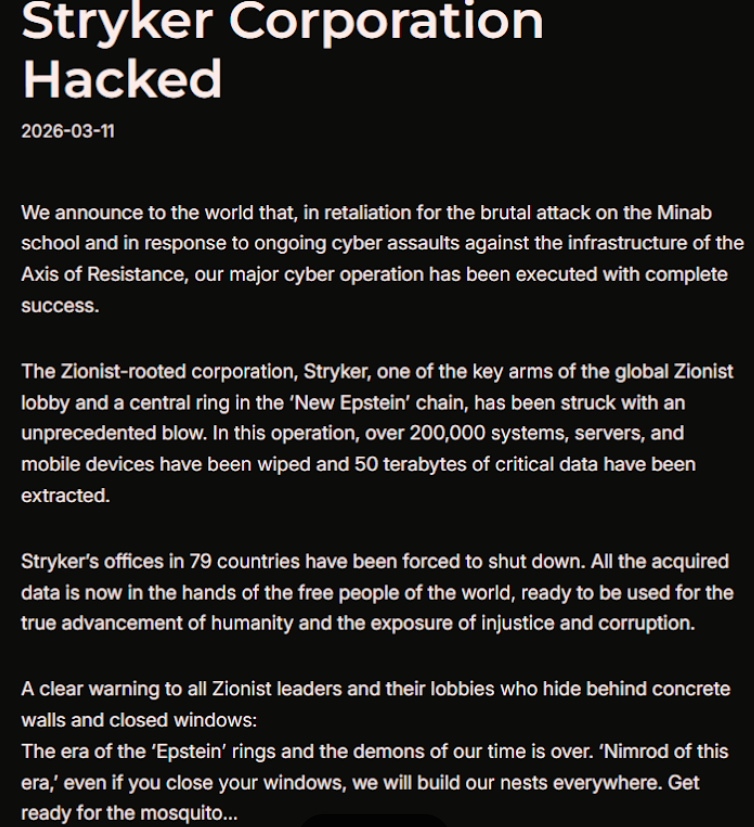
A hacktivist group with links to Iran's intelligence agencies is claiming responsibility for a data-wiping attack against Stryker, a global medical technology company based in Michigan. News reports out of Ireland, Stryker's largest hub outside of the United States, said the company sent home more than 5,000 workers there today. Meanwhile, a voicemail message at Stryker's main U.S. headquarters says the company is currently experiencing a building emergency.
Microsoft Corp. today pushed security updates to fix at least 77 vulnerabilities in its Windows operating systems and other software. There are no pressing "zero-day" flaws this month (compared to February's five zero-day treat), but as usual some patches may deserve more rapid attention from organizations using Windows. Here are a few highlights from this month's Patch Tuesday.

AI-based assistants or "agents" -- autonomous programs that have access to the user's computer, files, online services and can automate virtually any task -- are growing in popularity with developers and IT workers. But as so many eyebrow-raising headlines over the past few weeks have shown, these powerful and assertive new tools are rapidly shifting the security priorities for organizations, while blurring the lines between data and code, trusted co-worker and insider threat, ninja hacker and novice code jockey.
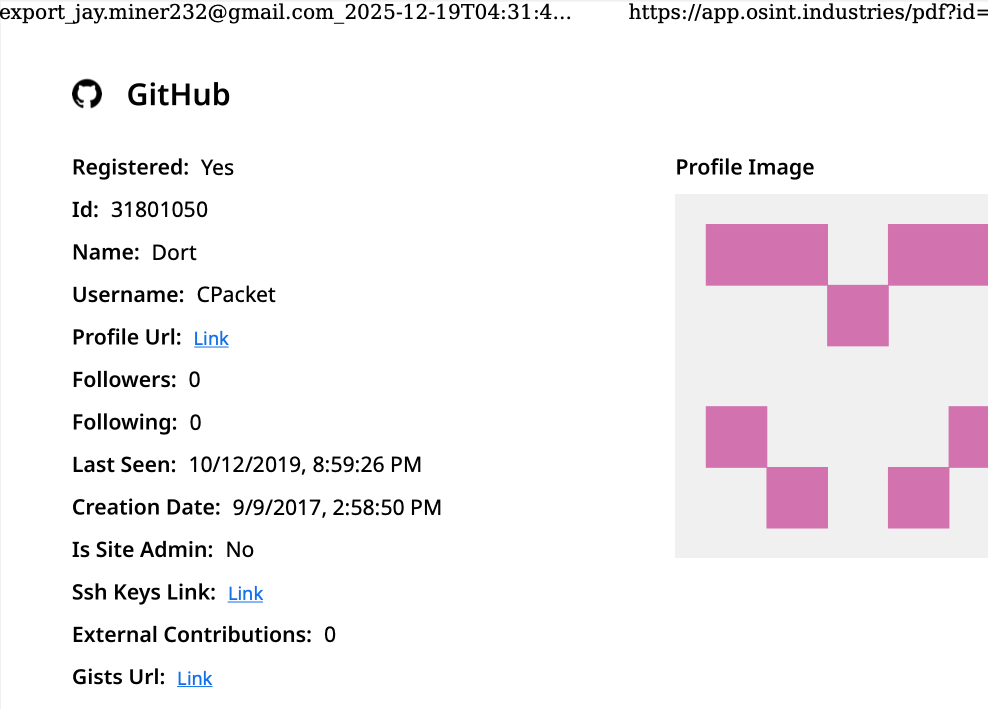
In early January 2026, KrebsOnSecurity revealed how a security researcher disclosed a vulnerability that was used to assemble Kimwolf, the world's largest and most disruptive botnet. Since then, the person in control of Kimwolf -- who goes by the handle "Dort" -- has coordinated a barrage of distributed denial-of-service (DDoS), doxing and email flooding attacks against the researcher and this author, and more recently caused a SWAT team to be sent to the researcher's home. This post examines what is knowable about Dort based on public information.

Most phishing websites are little more than static copies of login pages for popular online destinations, and they are often quickly taken down by anti-abuse activists and security firms. But a stealthy new phishing-as-a-service offering lets customers sidestep both of these pitfalls: It uses cleverly disguised links to load the target brand's real website, and then acts as a relay between the target and the legitimate site -- forwarding the victim's username, password and multi-factor authentication (MFA) code to the legitimate site and returning its responses.

Microsoft has released an emergency update to fix a Bluetooth device visibility issue on hotpatch-enabled Windows 11 Enterprise devices. [...]
Microsoft is working to address a known issue that renders the classic Outlook email client unusable for users who have enabled the Microsoft Teams Meeting Add-in. [...]
Last week's cyberattack on medical technology giant Stryker was limited to its internal Microsoft environment and remotely wiped tens of thousands of employee devices. [...]
CISA warned U.S. government agencies to secure their Wing FTP Server instances against an actively exploited vulnerability that may be chained in remote code execution attacks. [...]
Companies House, a British government agency that operates the registry for all U.K. companies, says its WebFiling service is back online after it was closed on Friday to fix a security flaw that exposed companies' information since October 2025. [...]

North Korean threat actors have been observed sending phishing to compromise targets and obtain access to a victim's KakaoTalk desktop application to distribute malicious payloads to certain contacts. The activity has been attributed by South Korean threat intelligence firm Genians to a hacking group referred to as Konni. "Initial access was achieved through a spear-phishing email disguised as a

The U.S. Cybersecurity and Infrastructure Security Agency (CISA) on Monday added a medium-severity security flaw impacting Wing FTP to its Known Exploited Vulnerabilities (KEV) catalog, citing evidence of active exploitation. The vulnerability, CVE-2025-47813 (CVSS score: 4.3), is an information disclosure vulnerability that leaks the installation path of the application under certain conditions

The GlassWorm malware campaign is being used to fuel an ongoing attack that leverages the stolen GitHub tokens to inject malware into hundreds of Python repositories. "The attack targets Python projects — including Django apps, ML research code, Streamlit dashboards, and PyPI packages — by appending obfuscated code to files like setup.py, main.py, and app.py," StepSecurity said. "Anyone who runs

Some weeks in security feel normal. Then you read a few tabs and get that immediate “ah, great, we’re doing this now” feeling. This week has that energy. Fresh messes, old problems getting sharper, and research that stops feeling theoretical real fast. A few bits hit a little too close to real life, too. There’s a good mix here: weird abuse of trusted stuff, quiet infrastructure ugliness,

If you run security at any reasonably complex organization, your validation stack probably looks something like this: a BAS tool in one corner. A pentest engagement, or maybe an automated pentesting product, in another. A vulnerability scanner feeding an attack surface management platform somewhere else. Each tool gives you a slice of the picture. None of them talks to each other in any